Showing posts with label World War II. Show all posts

Thursday, November 11, 2010

Courthouse World War II Exhibit

Our local Citrus County Old Courthouse Heritage Museum has a special display focusing on Florida in World War II. There is a special focus on our own Citrus County veterans, with memorabilia donated for the exhibit from Citrus County World War II veterans.
Florida had a large role in the American effort to win World War II. There was an active ship building program, agricultural efforts, radar stations, and numerous air bases built to provide both training facilities as well as patrols over the Gulf of Mexico and the Atlantic Ocean, seeking enemy ships.

From a press release from the Heritage Museum:
“At this time sixty-five years ago World War II was winding down. Germany had already surrendered to the Allied Forces and concentration camps were being liberated. In early August 1945 the United States unleashed the power of atomic weapons on Hiroshima and Nagasaki, to hasten the surrender of Japan. August 15, 2010 was the sixty-fifth anniversary of VJ day. These events are surely etched in the memories of those old enough to remember.

Among Citrus County’s large population of veterans, those who served during World War II are now aged in their eighties and nineties. To honor our World War II veterans, dubbed “the Greatest Generation” by newscaster Tom Brokaw, the Old Courthouse Heritage Museum, in downtown Inverness, is presenting an exhibition titled, Florida in World II, under the theme: World War II …Before the Memories are Gone. The exhibit will focus on the role of Florida in World War II and highlights the Attacks, the Civil Defense, Volunteering on the Home Front, Shipbuilding in Florida, The Cost of Victory, and How the War Changed Florida. Be sure to see this exhibit before or as part of the activities of Veteran’s week 2010 in November."
If you are in Citrus County and can visit the exhibit, do so soon. It ends this month.
And, it’s well worth the visit.
-

Tuesday, February 16, 2010

Death of a Quiet Hero: Miep Gies

Miep Gies passed away last month. Who was Miep Gies? Perhaps an exceptional lesson for our students to learn from.

Imagine….

Time: the early 1940s.
Place: Holland
Situation: Conquered by Nazi Germany in 1940, Holland was an occupied land. An order came down from the military: arrest and deport the Jews and other undesirables.

Your decision: You know of a Jewish family. Do you turn them in? Or do you try to help them avoid the order – and risk imprisonment and/or death if you are discovered?

That was a decision a young Dutch girl named Miep Gies had to make. Her decision affected not only the family she chose to support, but also revealed to the world the courage of individuals in the face of adversity and the horrors of the Nazi regime.

Gies was born in Vienna, Austria, in 1909, under her maiden name of Hermine Santruschitz. Following World War I, she was one of many malnourished children from Austria and Hungary that were invited to spend several months in the Netherlands to recuperate from the effects of the Great War. Her Dutch foster parents offered her a permanent home, and Gies was able to move to Amsterdam, where she grew to adulthood.

She was hired as an office assistant by a man named Otto Frank in 1933. As another war moved closer, Gies saw Austria annexed by the Germans, Poland invaded, and finally, on May 10, 1940, Holland occupied by the Nazis. She felt first-hand the bias of the Nazis when she applied for a marriage certificate – and had to prove her Aryan, non-Jewish heritage. She was able to do this with the help of family members, and on July 16, 1941, married Jan Gies.

Jan Gies became a member of the resistance, and became active in hiding those individuals wanted by the Nazi invaders. Miep Gies helped him, which provided her the experience to agree to provide supplies and support for Otto Franks, his family, and four of his friends when they went into hiding in the Annex.

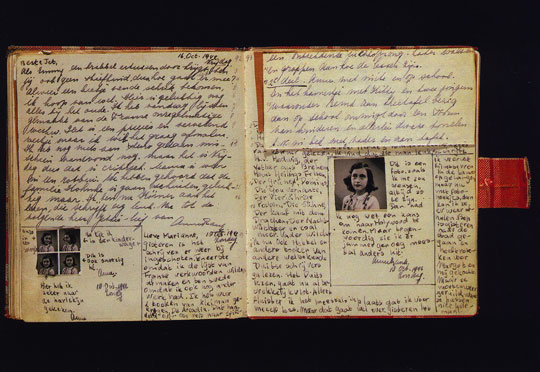
After the Annex was discovered and the Franks were arrested, Gies visited the Annex one more time – and picked up the papers that had been the diary of the young Anne Frank. She preserved the diary until after the war, and upon learning of the death of Otto Frank’s wife and two daughters, sought him out to return the diary to him.

The impact of that diary kept by a teenage girl has resonated around the world during the last 60 plus years. Millions of people around the world are aware of who Anne Frank was – and have read her diary. Over 25 million copies of the diary have been published since 1947, in 54 languages. Few are aware of the role that Miep Gies had in trying to provide and protect Anne and her family, and then preserving the Diary of Anne Frank so that posterity would know what happened at the Annex from July 5, 1942 to August 4, 1944.

Miep Gies passed away January 11, 2010, at the age of one hundred. As Gies said repeatedly over the years, “I just did what I could to help.” It would be a worthwhile effort of Social Studies teachers to bring the acts of this courageous and compassionate woman to the attention of their students and to discuss the choices each person makes when tyranny threatens civilization.

Sources:

Anne Frank Museum
Auschwitz
BBC News
Jewish Virtual Library
Miep Gies: Her Own Story
New York Daily News
Times Online

Photos:

Miep Gies in early 1930s, Miep Gies: Her Own Story
Miep and Jan Gies, wedding day, 1941, Anne Frank Museum
The Diary of Anne Frank, Jeff Werner
-

Sunday, December 20, 2009

'Thanks for the Memories' - Bob Hope

One of my sources mentioned that today (December 20) in 1920 Leslie Townes Hope received American citizenship. Hope was born in 1903 in England. His father moved the family to America in 1907 - though Hope often quipped that:

"I left England at the age of four when I found out I couldn't be king."
The family settled in Ohio, and Leslie became a naturalized citizen at the age of seventeen.
He was better known to Americans as Bob Hope. As I began to think about him - especially his efforts to entertain American troops during World War II (an on through Desert Storm) - I searched and found some resources that might be of use to our teachers in the classroom.

Army-Navy Screen Magazine presents a line up of stars from the Armed Forces Radio Service program "Command Performance" to entertain the troops. Filmed at Camp Roberts, California, this episode featured Hope as the host, along with a galaxy of stars who donated their time and efforts. Remember as you watch this that this was a show taped for radio broadcast - though with a live audience.

Bob Hope on Command Performance, WW II Part 1 and Part 2.

Discussion on the steak and the concept of meat rationing could be especially instructive, as well as the concept of humor to relieve crisis and stress.

A short (6 minute) but interesting compilation of Hope's USO career from World War II to Desert Storm is found here.

Finally, the Library of Congress provides information and resources on Hope's USO tours through their On the Road LOC exhibit site.

Photo Resources:

Bob Hope, Wikipedia
Bob Hope during a 1943 radio broadcast, Library of Congress
-

Sunday, December 6, 2009

Identifying a Pearl Harbor Picture and Using a Wordle


December 7th - Pearl Harbor day. I have a photo that I got from the Internet of Pearl Harbor that gives a view from (I think) a Japanese plane on that fateful day.
Unfortunately, I was not then yet marking my photos with added information - such as where I got them and what the title was.

Your help is appreciated: Can any of the readers of this blog help to identify the time, the ships, and the (Internet) source of the picture? I think I see an aircraft flying by one of the ships.
Remember: Pictures like this are primary resources too, and can help to enhance student understanding of an event, as well as to develop critical analysis skills.

On a second note - the last blog entry was on Wordles - so I became curious on the emphasis of words used in President Franklin Roosevelt's famous "Day of Infamy" speech. The wordle is below.

There are some pretty potent key words in this speech by Roosevelt, and this type of an approach could be an excellent starter for classroom discussion on the topic of American involvement in World War II.

Saturday, November 21, 2009

Mussolini + Brain + EBay


Glad to see that there is a continued interest in history.... (he says with tongue in cheek)

http://news.bbc.co.uk/2/hi/europe/8371171.stm

Or, for those interested, Galileo's lost body parts returned to 'responsible' hands....

http://news.bbc.co.uk/2/hi/europe/8371521.stm

Tuesday, August 4, 2009

Update: Three World War I Survivors


A brief update to the July 28th blog entry: According to the BBC, there are three survivors of World War I left alive today -


To read the article, click here.


I still stand by my published desire to not let the memories of other wars - and events - disappear. For more information and sites on saving the memories of veterans, see the July 28th blog entry.

-

Sunday, July 26, 2009

Book Review: The Lions of Iwo Jima


I just finished reading “The Lions of Iwo Jima: The story of Combat Team 28 and the bloodiest battle in Marine Corps history” by MG Fred Haynes and James Warren. The book is in our county library system, and was published in 2008.

If you have an interest in World War II, the Pacific arena, this would be a good read for you.

Combat Team 28 was assigned to participate in the invasions of Iwo Jima, to capture Mount Suribachi, and after the capture went on to fight throughout the Iwo Jima campaign. It was captured the last of the island after a bloody, draining month-long battle.

Fred Haynes was a young Marine captain in the 28th Combat Team. His memories, combined with solid research by Warren, provide an excellent first-person account of the action. His descriptions bring forth the horror of war and the dedication of those who fight it.

From the destruction at the beach to the raising of the flag (twice) at Mount Suribachi and from the constant deadly battle with snipers to the final bloody, exhausting days at Bloody Gorge a month after the invasion took place, this book provides an insightful view of what happened, with extensive research of documents, survivor interviews, and an intricately woven story.

Especially interesting is the chapter titled “The Enemy” which investigates why the Japanese fought as doggedly and self-sacrificing as they did, preferring death to capture.

For additional reviews, check at Amazon, Large Print Reviews, and McMillan.
Essential Question: What would be the effect today - given increased communications availability - of a battle such as Iwo Jima?
-

Sunday, July 12, 2009

Book Review: Visions from a Foxhole


I just finished reading a book written by a World War II veteran, and found it fascinating enough to share and encourage others to check it out and read it.

I always like the ‘grunts’ view of war – not the huge strategic plans moving armies and tens of thousands of men hither and yon. I like to read and share somewhat the experiences of the man in the trenches (World War I) or the foxhole (World War II) or the trenches again (Korea) or the fortified hamlets and firebases (Vietnam). These are men who did not know the whole scope of the war – their focus was on surviving day by day, hour by hour, minute by minute.

Visions from a Foxhole: A Rifleman in Patton’s Ghost Corps was written by 94th Infantry Division veteran William A. Foley Jr. – who was eighteen years old when he joined with the division in January 1945.

In his book Foley graphically describes the infantryman’s view of war – the shelling, the mines, the snipers, and the intense combat that, even in the last stages of World War II in Europe, was up close and personal.

What really stirred me with this book was the artistry of the author. He drew during the war, fleshed out the images, and now presents a selection of them in his book.

The author readily admits a lack of ability to remember names – I can relate to that – and some of the flow of events (though not the experiences) have faded over the years since the war ended. Combining his experiences with research on the 94th Division, Foley has created a credible story of survival during his five months ‘over there’.

Foley is was interviewed for the Library of Congress Veteran’s Project, and four of his drawings are posted there. It might be helpful to read the Amazon reviews as well.

Our local Citrus County library has this book available.

Essential Question: How could a resource like this book be used in a Social Studies classroom?

PHOTO SOURCES:

Library of Congress Veteran’s Project
Amazon

-

Tuesday, June 30, 2009

July 1, 1943: Pay-As-You-Go Income Tax Begins


1943: Tops songs like “Comin’ in on a Wing and a Prayer” by the Song Spinners and “I’ll Be Home for Christmas” by Bing Crosby filled the airwaves. World War II was beginning to turn in America’s favor as the Japanese and German expansion in the Pacific and Africa were stopped, then thrown back through such costly victories at Tarawa in the Pacific and defeat of the Afrika Corps in North Africa, followed by the Allied invasion of Sicily - then Italy - in Europe. Millions were eligible for the draft in the United States, women were holding traditionally men’s jobs, and we were committed that the men and women in the military were to be supported in any way possible.

It was the year of the steel penny (copper was to valuable to put in pennies – it was needed for the war industries), rent control, and rationing – which now included canned goods, meat, fat, cheese, and shoes. Bread had to be sliced at home, meat was rationed at 28 ounces per person per week, and the government ordered minimum forty-eight hour work weeks at key defense industry plants.

And it was the year that the pay-as-you-go income tax was incorporated into the American scene.

While it had been tried before – during the Civil War and after – Income Tax achieved constitutional legality with the passage of the 16th Amendment in 1913. March 15th became the traditional due date for the last of yearly tax payments made quarterly by corporations and upper income groups. The lower income groups did not have to pay income tax at this time. However, the tremendous expenditures of monies by the United States at home and abroad during World War II created a fiscal nightmare. Henry Morgenthau, U.S. Secretary of the Treasury, advocated a pay-as-you-go format on an increased base of income levels so that there would be a constant flow of monies into the government coffers to meet the emergency expenses of war as well as to combat inflation.

On July 1, 1943 – after much debate and compromise - Congress passed the Current Tax Payment Act, placing a withholding tax on wages and salaries in order to allow workers to stay current with their tax liabilities, and to provide continuous and regular funding for the war effort. It was the result of efforts by Beardsley Ruml, Chairman of the New York Federal Reserve Bank and treasures of Macy and Company, who was championing the new form of collecting taxes. He asked in his pamphlet what would happen if American “just started paying income tax, but on this year instead of last year?” He proposed to “forgive” the 1942 tax bill in order to avoid double taxing. The end result of compromise and the wording of the new law forgave taxes on lower incomes, maintained them on high incomes, and began collecting through withholding on all incomes. The withholding rate during this financial crisis caused by the huge expenditures of World War II: 19% on an annual income of $2000, with up to 80% on incomes over $200,000.

A strong advertising campaign was organized in print and radio. Walt Disney was recruited to create a film showing that paying ‘taxes to beat the Axis’ was patriotic – a task that cartoon character Donald Duck did in The Spirit of '43. Noted composer Irving Berlin included lyrics in a song titled “I Paid My Taxes Today” that supported the income tax: "You see those bombers in the sky, Rockefeller helped to build them, so did I, I paid my income tax today."

The American public liked the idea, and by year’s end 74% of Americans were paying income tax – through withholding – financing the war effort. The idea of pay-as-you-go through withholding is still with us 64 years after war’s end.

Essential Question: How could students best investigate and analyze the advocacy used by the Federal Government to promote the concept of pay-as-you-go taxation?

WEB RESOURCES:

Income Taxes are Cartoon Images of the Law
Kilroy was Here
Income Taxes, War, and the Mennonites
Randolph Paul Address, 1943
Revenue Objectives of the 1943 bill
Sixteenth Amendment
The Dirty Truth About Income Taxes
The Plan That Slogans Built
YouTube

PHOTO RESOURCES:


-

Sunday, June 21, 2009

Interpreting Operation Barbarossa


Politics makes strange bedfellows – and what can be classified as perhaps the strangest international bedfellow mix was that of Nazi Germany and the communist Soviet Union.

Hitler, a rabid anti-Communist, agreed with the Soviet Union to partition Poland in 1939. He had planned all along to destroy the country, but needed to secure one border while he waged war in the West against France, Britain, Belgium, and the Low Countries.

Hitler had the plans for attacking the Soviet Union drawn up in in the fall of 1940, but the stubbornness of Great Britain in withstanding the attacks of the German air force and naval units at home and abroad, postponed the plans for a year. In 1941 – despite the continued resistance of Britain at home and in North Africa, Hitler decided he had to destroy his ideological enemy, the Soviet Union. Actually, Josef Stalin, the dictator of the Soviet Union, had foreseen an upcoming war with Germany – but on his terms and his plans, which involved plans for an attack against Germany in July of 1941.

While Operation Barbarossa was scheduled to start on May 15, 1941, but difficulties in the Balkans – where German forces rushed in to assist the Italians in Greece and Crete – and the sending of the Afrika Corps to North Africa temporarily drained some of the troops and equipment needed

At 3:15 a.m. on Sunday, June 22, 1941, the largest invasion in history began – some 3.9 million German and allied soldiers, 3580 tanks, 7184 artillery guns, 1830 planes and 750,000 horses. The delay in launching the attack was costly – Hitler made the same mistakes as Napoleon did in 1812, seeking to conquer territory and cities and placing a priority on complete destruction of the enemy’s military machine. His troops were stopped at the gates of Moscow, and the next four years would be long, bloody, and epic in their suffering and destruction.

While arguably Hitler made many blunders during World War II, this was perhaps the biggest one, setting up a two-front war, leaving a defiant England behind, draining troops and equipment that was needed on other fronts (most specifically North Africa), and repeating the mistakes of Napoleon from almost a hundred and thirty years before.

Overextended supply lines, underestimating the resiliency of their opponents, faulty intelligence, overextension of German forces involved in a two (actually three, including North Africa at the time) front war would cause a catastrophic failure that in the end would result in the destruction of Germany.

I can’t help but wonder if historians will look back and lay an ‘Operation Barbarossa’ at America’s feet – and what that act will be. Is such an event in our near or distant future – or has it already occurred and we don’t realize it.

Essential Question: How can we best utilize events of the past in an engaging and interactive way to create an understanding of the wider scope of history to our students?

Photo Resources:

01. German infantry: Discovery Channel
02. Invasion map: Century of Flight
03. Soviet poster during WW II: Soviet Library

-

Tuesday, June 2, 2009

The Longest Day

This Saturday is June 6th – the 65th anniversary of the Allied landings on the beaches of Normandy, perhaps the greatest invasion landing force ever launched. Precious few of those who were there survive today to tell their story to this generation.

Do we encourage our students to commemorate this event? Or realize its significance? There are a variety of ways to learn more about D-Day. For instance, the students could be directed to websites with veteran interviews:


-Veterans History Project
-National D-Day Memorial
-American Experience

Or, some interesting and readable books that would pique the interest of the students. While many books on this subject are available, some of my favorites are:

-D-Day June 6, 1944: The Climatic Battle of World War II, by Stephen Ambrose
-True Stories of D-Day, by Henry Brook
-D-Day Survivor, by Harold Baumgarten
and my personal favorite:
-The Longest Day, by Cornelius Ryan

There are also a lot of films available concerning D-Day. The History Channel will undoubtedly be running some shows, and some of the many movies available are:

-Saving Private Ryan
-Band of Brothers

and, The Longest Day DVD

I usually listen to segments of the 24-hour radio broadcast to get the idea of the excitement over the invasion caused by the news releases of the day. The collection is located through a link near the bottom of the page on our Social Studies website.

For primary resources on D-Day, visit NARA where they have lessons and materials on the invasion, including Eisenhower’s letter that he wrote ‘in case of failure’.

What does my June 6th look like? Some radio, and watching The Longest Day with my family – pretty much an annual event in our household.

Essential Question: What could our teachers and students do to personally recognize D-Day?

Photo Resources:

Dday 01. Landing Craft: NARA
Dday 01. The Longest Day book by Cornelius Ryan
Dday 03. Eisenhower Note: NARA

-

Monday, January 19, 2009

Book Review: Dawn Like Thunder

Dawn Like Thunder: The True Story of Torpedo Squadron Eight by Robert Mrazek was a fascinating book on the U.S. Navy Torpedo Squadron that suffered grievous loses at Midway, and went on to serve at Guadalcanal. It was perhaps the most decorated air unit of the war.

The book is a compelling story of the men who made up Torpedo Eight, and went on to fight, suffer, die, and finally emerge victorious in two of the turning points of World War II in the Pacific.

While I had read quite a bit about the Battle of Midway before, and knew that “Tex” Gay was one of the few survivors of the squadron there, this book opened a door that gave a clear picture of what it was like flying the Navy’s first torpedo plane – the outmoded, slow ‘Devastator’, pictured below. Only a few of the more advanced TBF Avenger’s were available at Midway – and the survival story of one of these planes, piloted by Bert Earnest, was fantastic.

While there is a lot of technical information in the book, it is woven into the story of the men, and is used to explain the conditions that they fought under. I truly enjoyed the approach the book used, and the in-depth information it shared.

I have to admit, when I first saw the title Dawn Like Thunder, my mind went back to a book I’d read years ago, Dawn Like Thunder: The Barbary Wars and the Birth of the US Navy. I really enjoyed that book – and used the information in class – just as I really enjoyed this book. It was a quick read, focused on the personalities and capabilities of the men and machines that fought in World War II.

It’s a good read. If the opportunity presents itself, pick up a copy over the summer. The public library might have a copy available by then! I'm planning on donating my copy!